Dale Farm sees turnover grow to over £749m

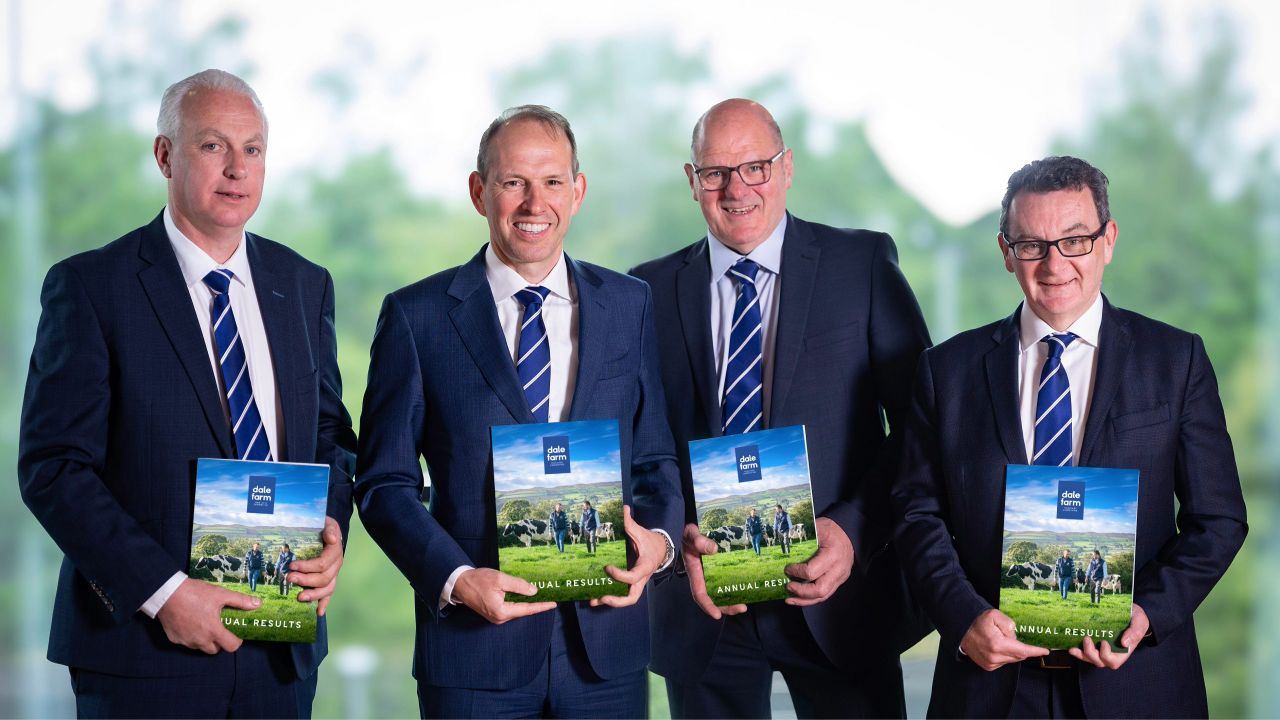
Northern Ireland dairy co-op Dale Farm has reported a "strong financial performance" for the year ending March 2026.
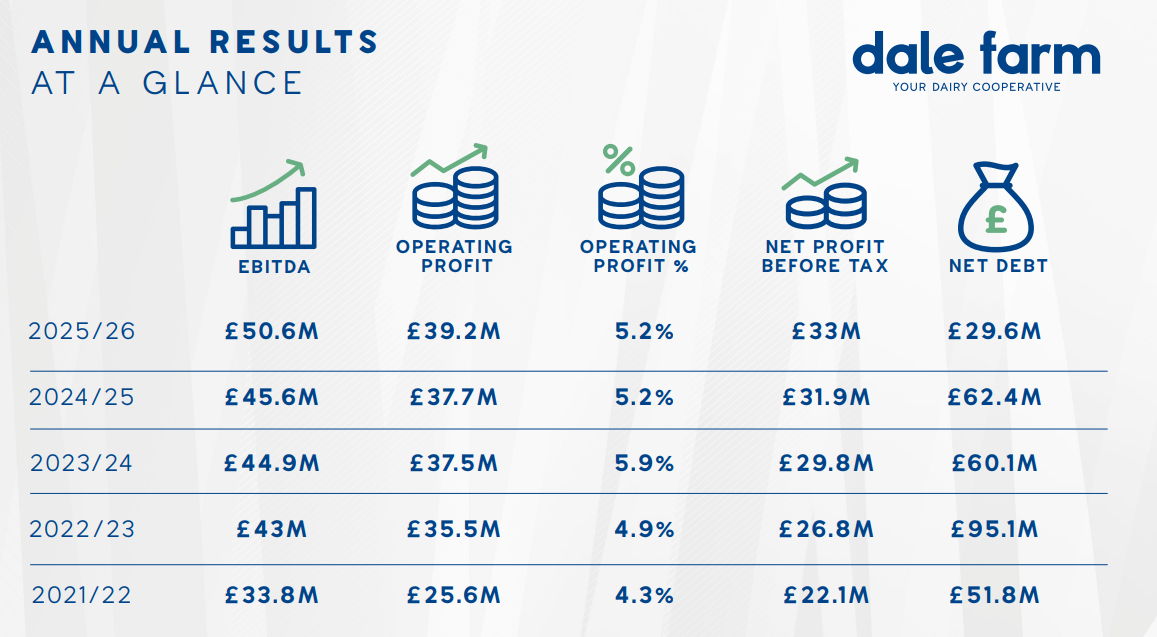
Turnover increased by almost 4% year-on-year from £722.4 million to £749.3 million.
The results show that EBITDA (earnings before interest, tax, depreciation and amortisation) was up by 11% from £45.6 million to £50.6 million.
Operating profit rose by 4% to £39.2 million and net profit before tax rose by 3.4% to £33 million.
The figures also show that net debt reduced by £32.8 million to stand at £29.6 million.
During the 2025/26 year, Dale Farm said it paid a "leading and competitive milk" price to its farmer suppliers, with an average of 40.38p/L.
The co-op also issued over £10 million to its farmers by way of a 13th payment consisting of an additional 1p/L on every litre supplied during the year.
Dale Farm
Speaking with Agriland, Nick Whelan, Dale Farm group chief executive officer (CEO), said it was "a consistent set of results".
"The most pleasing thing is we're able to pay a strong milk price. That's the raison d'etre of a co-op.
"At the same time, we're going through a significant period of investment in the business and transformation. To invest, you need to generate cash.
"We're not about saddling the co-op with a lot of debt. We're not about going out and asking our farmers to pay for that transformation. We're funding it out of cash flow, out of EBITDA.
"That’s why it's pleasing to get consistency in those EBITDA figures.
"We’ve had a good run at it now, the last five years in particular have been quite strong. Stability and consistency is the name of the game for us," he said.
Investment
In a competitive and volatile global dairy market, Whelan stressed the importance of standing out from other co-ops.
"We're never going to win it on scale here. So, we have to win it on service, quality and technology.
"They're the three things that you need to be investing consistently to differentiate yourself with your customers,” he said.
Following a £70 million investment at Dunmanbridge, further upgrades are underway to bring total cheddar capacity at the site to 100,000t.
The co-op has also secured approval for three patents in curd technology.
While always keeping an eye on developments in New Zealand, Dale Farm has also turned its attention to both the "threats and potential opportunities" offered by the US.
"There's an enormous transformation happening in the US dairy industry, both at farm and processor level. There's incredible investment.
"Last year, I think the figure was $11 billion in dairy equipment alone,” Whelan said.
"The scale at which they're building plants, bringing in digital automation and efficiencies, you have to be abreast of that. If you are going to be a global player, you've got to be competitive,” he added.
Whelan said that Dale Farm is “optimistic” about value-add products globally, along with the “insatiable demand” for different types of protein.
He said that Dale Farm is “putting a lot of R&D and focus” into GLP-1 weight-loss drugs and how they can potentially expand in that area.
Milk
There are currently around 1,250 milk suppliers in Dale Farm, with around 20 to 25 new entrants annually.
Over the past two years, the co-op’s milk pool has grown by 13%. In the past year, the milk pool increased to 1.05 billion litres.
"Five years ago, our average milk yield was just over 7,000L per cow. This year, it was over 8,100L per cow. That's an enormous change.
"That's on the average of every cow here that we have, so we've added 1,000L for every cow in less than five years. That's probably going to continue.
"We’re seeing significant advances, particularly in genetics. We have some farms that are on the extreme end of the genetics, and their average is 14,000L per cow," Whelan said.
"We’d be encouraged that there's great potential for growth in milk and we're planning for that. We're planning for growth in our milk pool, not necessarily a growth in the cow population," he added.
The Dale Farm chief executive believes that milk price will likely be under pressure from where it stands today due to the global surplus of milk.
The co-op is currently supporting its milk price by 2p/L, but Whelan doesn’t know how sustainable that is in the longer term.
"If it was for the full year for us, it's over £20 million. That will put manners on you fairly quickly.
"There was a hope that the market would tighten up a little bit in the second half of the year and the start of next year. Just globally, it doesn't appear to be happening," he said.
Despite the challenges, Whelan said the co-op has a "very robust" five-year plan which he said is “showing significant growth” in milk price competitiveness and in the co-op’s earnings.
Digitalisation and automation will play a major part of the business’s strategy over the next three to four years.
Whelan also pointed to the need to be "brave and entrepreneurial around the positive trends in nutrition today".
Aurivo
Earlier this year, Dale Farm and Aurivo shelved plans for a merger of the co-ops and embarked on a strategic partnership.
"We put a lot of time into looking at the synergies between the two businesses. What we need to do is give stakeholders more time to reflect on the benefits that the synergies we're delivering," Whelan said.
He said that recent work between the co-ops on strategic projects has "identified a few million of benefits".
"We’ve two projects in particular that have gone very well since those talks. With a bit of luck, we'll be announcing maybe a co-investment and projects that we take forward together.
"They need another couple of months, but progress is actually ahead of plan in those, which is really encouraging," Whelan said.